Client reviews
“Send the review within three working days of receiving all materials, unless the project agreement specifies otherwise.”

KNOWLEDGE & REASONING IN CONTEXT
Your team’s knowledge is spread across documents, conversations and experience. Finding a plausible answer is not the same as knowing which information applies.
We investigate how people can trace an explanation to its sources, recognize a gap, and decide what to use.
Explore a changing answer
A QUESTION IN CONTEXT
A project lead asks: “When should we send the client’s review?” Change what is known and see why the answer needs to change with it.
WHAT THE SOURCE SAYS
“Send the review within three working days of receiving all materials, unless the project agreement specifies otherwise.”
All materials have arrived. No project-specific exception has been supplied.
The standard gives a starting point. The condition in the same sentence matters just as much as the deadline.
A useful answer preserves the qualification.
WHAT THE SOURCES SAY
Unless the project agreement specifies otherwise.
“For this project, send the review by the end of the next working day after all materials arrive.”
Its authority and scope matter—not simply its later date. The playbook explicitly allows this project-specific exception.
Retrieving both passages is not enough. Their relationship must remain visible.
WHAT IS KNOWN
The agreed deadline is not recorded in the material available to the team.
The standard playbook is available. The agreement that may override it is not.
Repeating the standard would conceal an unresolved exception. A helpful system should identify the gap and make it easy to resolve.
Sometimes the useful result is a better question.
WHY IT IS DIFFICULT
You may find more sources and still face conflicting answers. To decide what to use, you need to check what each source actually supports.
A general rule, a project exception and an informal note have different roles. We are interested in making scope, authority and unresolved conflicts explicit—not treating every retrieved passage as interchangeable.
A reference may concern the right topic while missing the qualification that changes the answer. The research question is whether people can detect that mismatch without redoing the entire task.
Asking for every missing detail creates work. Guessing a consequential detail creates risk. The useful balance depends on the decision, its reversibility and what the person can verify.
WORK YOU CAN EXAMINE
Our Learning Studio prototype brings selected materials, passage references and recall activities into one workspace. It gives us a concrete setting in which to examine checking and understanding.
It is in development. The recorded example uses sample material and prewritten excerpts, not a live AI response. We have not established that it improves verification accuracy or learning outcomes.
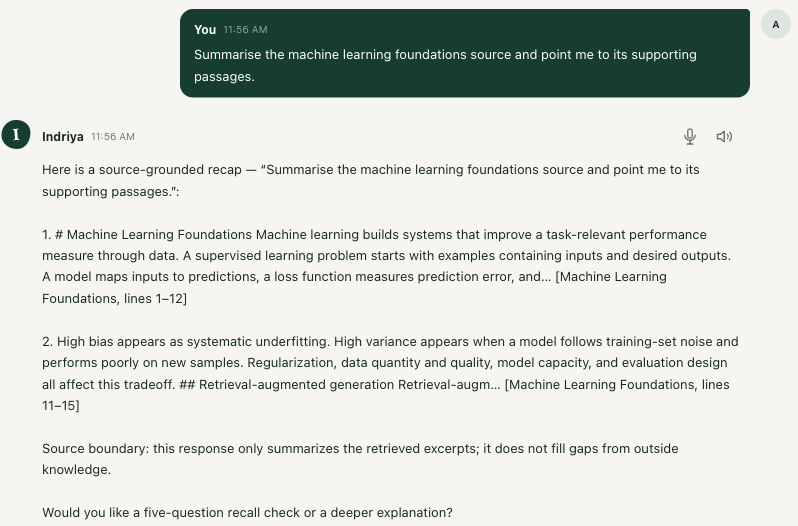
We would compare a bounded task against the participant’s current reading and checking workflow. Include supported claims, misleading references and missing evidence; examine corrections, task completion and effort together. A faster answer is not sufficient if important errors go unnoticed.
Task-based walkthroughs and source checks are described in our proposed evaluation plan. Participant recruitment, scoring and study design remain to be finalized; these are not completed findings.
Read the draft evaluation plan ↓Related reading: Lewis et al., Retrieval-Augmented Generation for Knowledge-Intensive NLP Tasks (2020) describes combining retrieval with generation. It provides a foundation for examining how retrieved evidence is interpreted and checked in a particular task.
PUT YOUR QUESTION TO WORK
For a small business, it may be a handover that depends on one person’s memory. For an enterprise team, it may be conflicting guidance across approved sources. For a researcher, it may be how to measure whether an explanation is genuinely supported.
Bring a non-confidential example of the task and the information it depends on. We can explore the fit for a bounded prototype or evaluation, with data access and success criteria agreed before work begins.
Discuss a knowledge problem