

← Research at Indriya

PERCEPTION & ASSISTIVE SYSTEMS

When does a signal become useful to you?

A sound may matter in one setting and distract you in another. Assistance needs to fit your surroundings, your attention and the moment you need it.

We explore hearing, environmental context and adaptive feedback: how a system could connect what it senses to assistance a person actually wants.

See why the surroundings matter
Illustrative researcher and participant considering a sensory wearable together
The person’s experience is part of the research question. Illustrative scene.

SIGNAL, SETTING, PERSON

Change the setting.
Reconsider the cue.

Imagine an assistive device detecting a short notification tone. Identifying a sound is only one part of deciding whether and how to draw someone’s attention to it.

Illustrative concept · prewritten scenarios, no sound processing or device connection

THE SITUATION

Quiet.

One notification tone stands out from the background.

A distinct signalA person workingA preferred cue
A QUESTION OF USEFULNESS

Would a discreet cue
add something useful?

If the person has asked for notification support, a visual or tactile cue might help. The system still needs a way to respect preference and avoid redundant alerts.

Detection should connect to a chosen form of assistance.

WHY IT IS DIFFICULT

What would make
this assistance useful?

Recognizing a signal is not enough. You also need to consider who receives the cue, where they are and what they are trying to do.

What does the signal mean here?

Background noise, competing inputs and uncertainty about the source can change the interpretation. Our interests include audio and multimodal context, while keeping the difference between a detected signal and an inferred meaning explicit.
How should feedback adapt?

Preferences and needs vary between people and over time. We ask how correction and interaction could guide assistance without requiring someone to continually configure or supervise it.

What should an evaluation capture?

Signal accuracy alone cannot describe a helpful experience. Timing, missed or unnecessary cues, attention, effort and user control would need to be examined for a specific task and population.

RESEARCH SCOPE

Explore assistance
beyond signal detection.

Our direction includes hearing, assistive experiences and adaptive feedback. Sensory restoration remains a longer-term research interest within this area.

Potential investigations include context-aware cues, ways to incorporate user correction, and evaluation that considers real environments alongside controlled conditions. These questions could be relevant to assistive technology teams, wearable-product builders and researchers.

Research stage. No clinical product is available; no clinical efficacy or regulatory approval is claimed.

Discuss a perception research question ↗
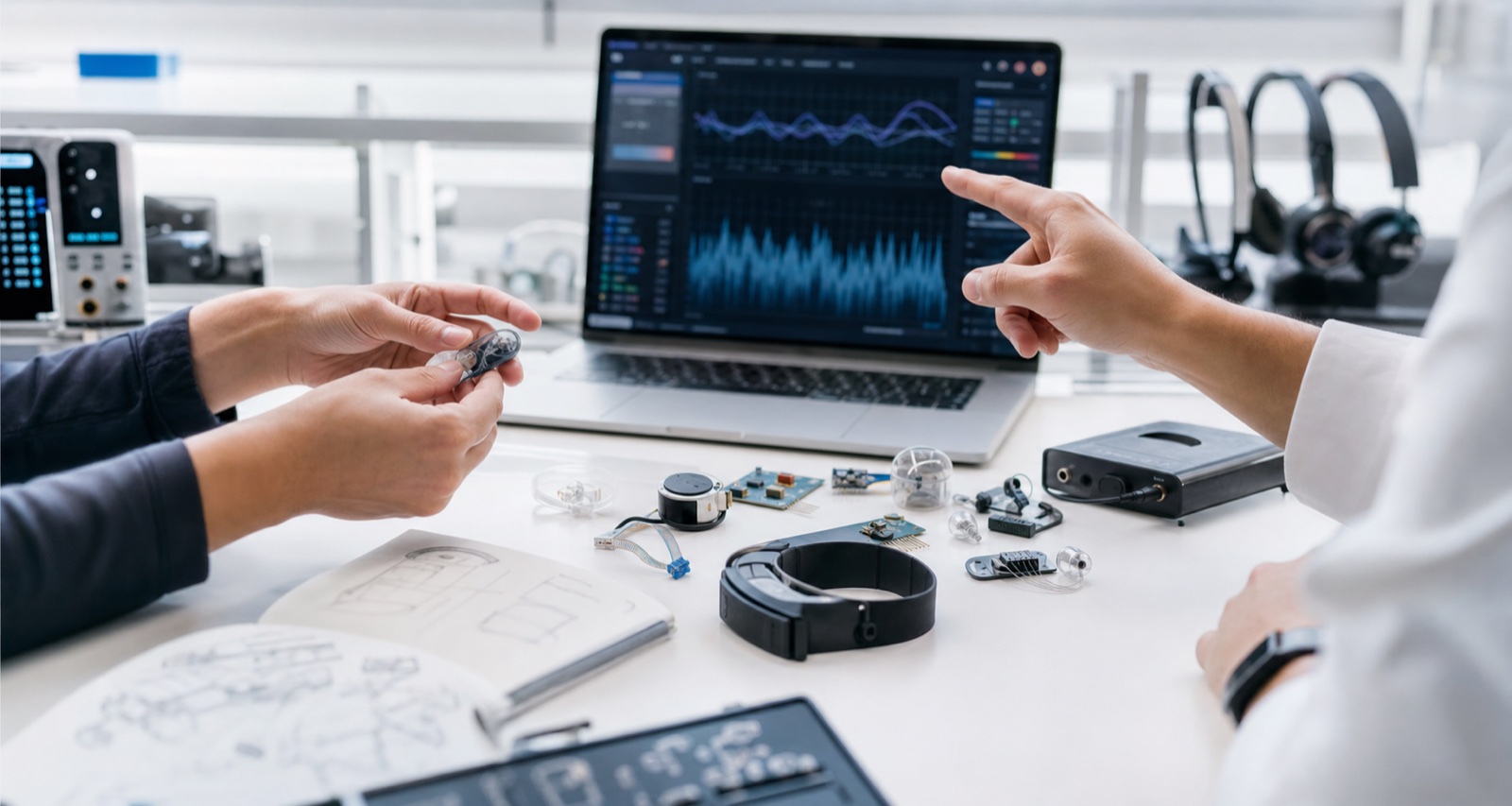
Illustrative workbench with sensory-device components and a signal display
Illustrative workbench scene. Devices and signal displays show the research context, not measured results.
What would a meaningful evaluation involve?

Start with a specific assistive task, intended users and clearly described environments. Define the limits of the system and distinguish useful assistance from missed, unnecessary or misleading feedback.

A proposed study would examine interpretation and the experience of the person using the assistance. Any work involving participants would need appropriate consent, domain expertise and a study design suited to the task. Clinical questions would require a separate clinical and regulatory pathway.

Related reading: Amershi et al., Guidelines for Human-AI Interaction (2019) considers interaction over time, correction and user control. It is a general interaction foundation, not a clinical evaluation method.

PUT YOUR QUESTION TO WORK

Bring the environment.
And the human need.

What is the person trying to do? Which signals matter? Where does current assistance fall short? These are useful starting points for a device team, an accessibility practitioner or a research collaborator.

We welcome discussion of a bounded research question, the expertise it requires and how to evaluate it responsibly.

Discuss an assistive experience