Following the energy
Energy is transferred in food from grass to a grasshopper, then to a frog. Energy flows through the chain; it does not cycle back to the grass.

LEARNING & HUMAN GUIDANCE
The answer makes sense while it is in front of you. Then you need to explain it, teach it or apply it to a different problem.
We investigate guidance that helps people make that transition—with sources they can inspect, practice that reveals a gap and support that fits the situation.
Explore two kinds of support
FROM READING TO REASONING
In a Grade 7 science lesson, students are learning how energy moves through a food chain. Compare a complete explanation with a prompt that helps someone build their own.
THE SAME SOURCE IDEA
Energy is transferred in food from grass to a grasshopper, then to a frog. Energy flows through the chain; it does not cycle back to the grass.
A complete explanation can be useful. Reading it alone does not tell a teacher whether the student can explain the arrows or apply the idea.
The question shifts from “Was an answer supplied?” to “What can this person now do?”
A PROMPT TO THINK WITH
“Energy moves from ___ to ___ because ___. The arrow points this way because ___.”
Then ask: could fewer grasshoppers affect the frogs? Use the feeding links and identify what else you would need to know.
The frame helps a learner begin without supplying the full reasoning. Their response gives the teacher something to examine, question and adapt.
Whether this support produces better independent understanding is a question to evaluate—not a result established by this example.
WHY IT IS DIFFICULT
A more complete answer can remove the very thinking someone needs to practise. Too little support can leave them unable to begin.
A worked explanation, a question and a reasoning frame serve different purposes. We investigate how the task, prior knowledge and available time should influence the support—not simply the length of the response.
Fluency and confidence can be misleading. Explaining in one’s own words, identifying an unsupported claim and applying an idea to a changed situation are different things to examine.
A correction might indicate a factual error, a misconception or a poorly framed task. Guidance needs to respond to the right problem while leaving teachers and learners in control.
WORK YOU CAN EXAMINE
Our teaching example lets you change lesson length and support for reasoning. The activities and downloadable plan change together, while the learning objective remains fixed.
Teacher Copilot is an available toolkit for grades 6–12 educators. Learning Studio is an in-development workspace for selected sources, explanations and recall. Together they provide settings for examining guidance and review.
The examples demonstrate design choices. We have not yet established improved learning outcomes through a completed study.
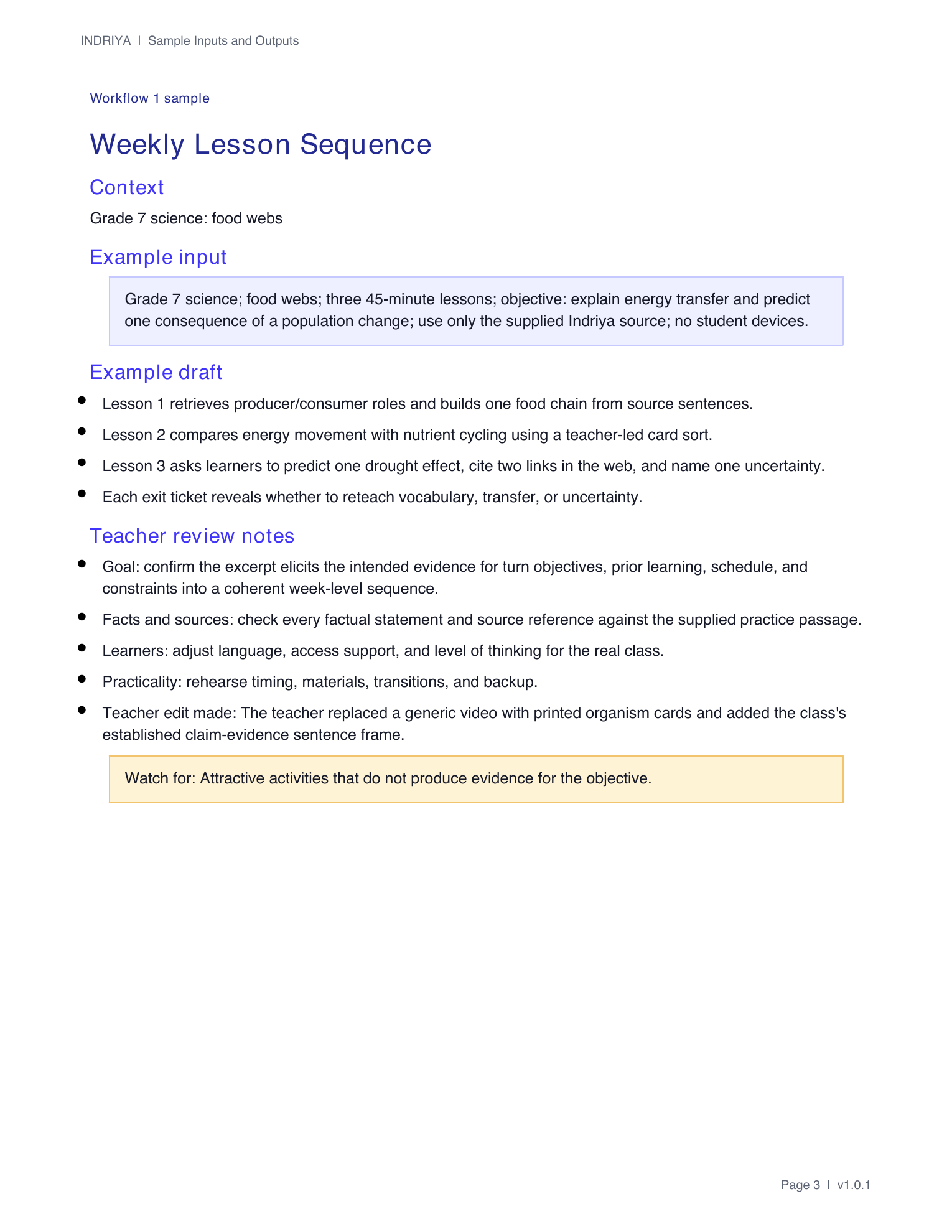
Our draft evaluation plan proposes source checks, explanation tasks and later recall, compared with a participant’s existing learning workflow. It considers accuracy and effort together. Recruitment, scoring, task balance and follow-up timing still need to be specified.
For classroom work, the teacher’s objective and school requirements would guide any study. Public examples use no identifiable student information. A professional learning study would need its own tasks and measures; results should not be assumed to transfer between populations.
Read the draft evaluation plan ↓Related reading: Amershi et al., Guidelines for Human-AI Interaction (2019) offers a foundation for examining useful feedback and human control. It is an interaction reference, not evidence of educational efficacy.
PUT YOUR QUESTION TO WORK
An educator may want students to explain rather than reproduce an answer. A business may want a new colleague to apply a procedure independently. A researcher may want to distinguish helpful guidance from over-reliance.
Bring the learning task, the sources and the point where understanding breaks down. We can explore an appropriate example or research question with you.
Discuss learning and guidance