How much should the system do?
Every approval can add friction; removing the wrong one can remove meaningful control. We are interested in how to assign responsibility around consequential steps and make intervention useful rather than ceremonial.

RELIABLE AI WORKFLOWS
Your team still needs to check the draft, resolve exceptions and decide whether to act. Those handovers matter as much as the output.
We investigate how to guide multi-step work while keeping evidence, oversight and recovery within reach.
Follow a task through an exception
FOLLOW THE WORK
A team prepares a weekly project update. The words may be ready even when the process is not. Explore what should happen when a condition changes.
Current updates found
Changes summarized
Person checks and approves
Wait for approval
The reviewer needs the proposed message, what changed and the source of each consequential claim. A polished paragraph alone is not enough to make the decision.
Schedule change found
New date is unconfirmed
Ask the project owner
On hold
The team can keep the draft while asking the responsible person to confirm the date. Silently treating the draft as approved would cross a boundary the workflow is meant to preserve.
Sources retained
Approval recorded
Connection interrupted
Check delivery before retry
An interrupted connection does not tell you whether a message was delivered. The next step is to reconcile the delivery state, preserve the approval record and avoid sending a duplicate.
WHY IT IS DIFFICULT
You can connect the tools and still need to decide when to proceed, pause or ask for help. That decision depends on the task and the cost of being wrong.
Every approval can add friction; removing the wrong one can remove meaningful control. We are interested in how to assign responsibility around consequential steps and make intervention useful rather than ceremonial.
Inputs, revisions, permissions and prior actions all affect a safe next step. Multi-step and agentic workflows need a way to distinguish work that is incomplete from work whose outcome is simply unknown.
Finishing faster can hide extra checking or downstream rework. Evaluation needs to consider the whole task: useful completion, errors, intervention effort and the ability to recover.
WORK YOU CAN EXAMINE
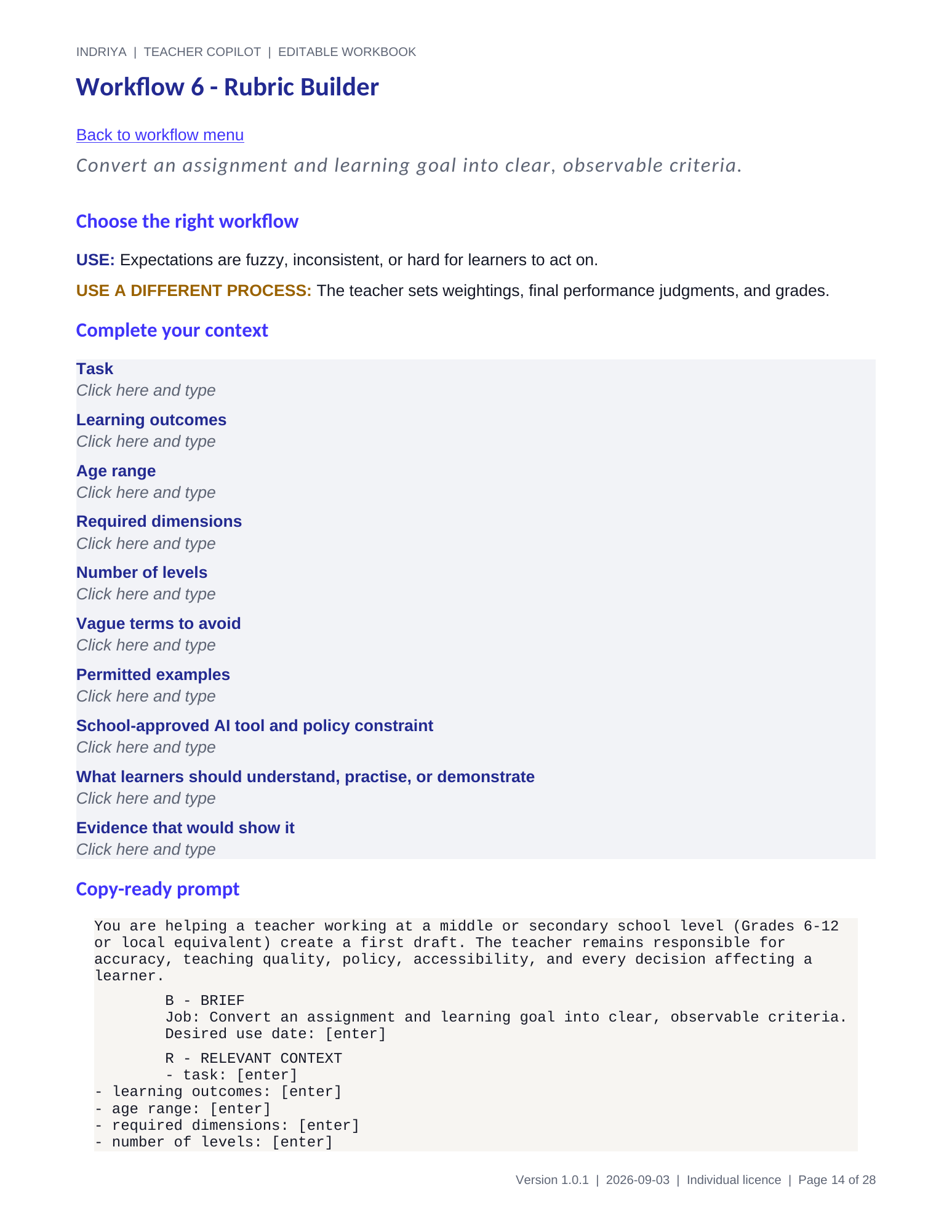
Teacher Copilot’s available toolkit structures twelve recurring jobs around context, an editable draft and review. BuyerProof’s free exercise separates observations, assumptions and a next action.
These artifacts provide concrete ways to examine guided work. Our research extends the question to multi-step systems: how should context and human control persist as more of the work becomes automated?
The toolkit and exercise are available to explore today. The automated workflow above is a prewritten illustration of the wider research direction.
Start with a recurring task and the team’s current way of completing it. Define the permitted actions and who can approve them. Compare normal cases with missing inputs, conflicting instructions, interrupted tools and repeated requests.
A proposed evaluation would record useful completion, errors, reviewer effort and recovery behavior—not only the quality of the initial draft. The tasks and acceptance criteria need to be agreed with the people responsible for the work.
Related reading: Amershi et al., Guidelines for Human-AI Interaction (2019) and NIST’s AI Risk Management Framework provide starting points for considering interaction and risk. These are external references, not certifications of an Indriya system.
PUT YOUR QUESTION TO WORK
A business owner may want a clearer client handover. An enterprise team may need an approval boundary that survives a tool failure. A product builder may want to examine how an agent should ask for help.
Bring the task, the exceptions that matter and who owns the result. We can discuss a focused investigation, with integration boundaries and evaluation expectations established before implementation.
Discuss an AI-assisted workflow